
Crypto can feel like a maze. Prices jump and crash. New coins pop up every week. And half the “tips” you see online are just noise.
So when people search for lessinvest.com crypto, they want one thing — clarity. They want to know if this site is legit, what they’ll actually learn, and whether it’s worth their time.
This guide covers all of that. And more.
We looked at what the site teaches, where it’s strong, and where there are gaps. We also added real steps you can take right now, plus a few things most crypto beginner guides never mention.
What Is LessInvest.com Crypto?
LessInvest.com is a free financial education website. Its crypto section teaches beginners how digital money works — without trying to sell you anything.
You won’t deposit cash there. There’s no trading tool. No signals. No paid course hiding behind a paywall.
It’s a reading site. Simple articles that break down big ideas into plain words.
The whole site runs on one core idea: spend less, invest more. Cut small costs. Free up cash. Then put that cash into assets like crypto over time.
For many people, that’s the most useful advice they’ll ever get.
Why This Approach Actually Works?
Most crypto content online wants you to act fast. Buy now. Don’t miss out. This coin is about to explode.
LessInvest.com does the opposite. It slows you down.
That matters. Here’s why:
Fear and greed cost people real money. Studies on retail investor behavior show that most people buy high (when they’re excited) and sell low (when they’re scared). A calm, education-first mindset helps break that habit.
Knowing the basics also helps you spot scams. Crypto fraud hit over $5.6 billion in losses in the US alone in 2023 (per FBI data). Most victims had little financial education. Learning first is a form of protection.
What LessInvest.com Crypto Actually Covers?
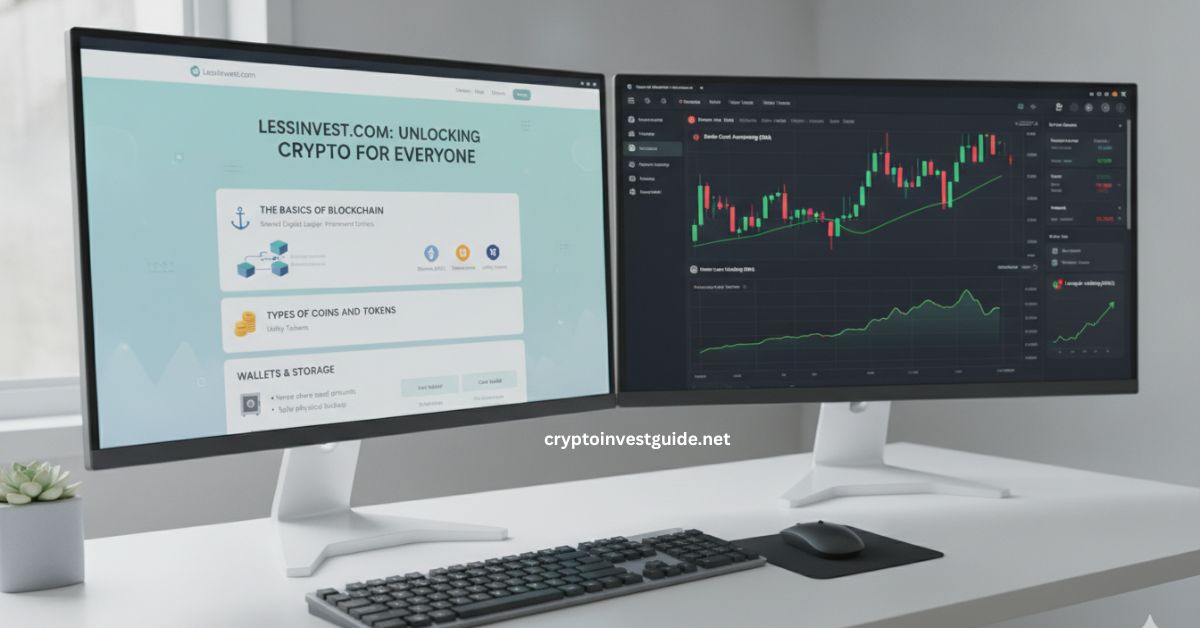
Here’s a breakdown of the main topics the site teaches:
The Basics of Blockchain
Blockchain sounds complex. LessInvest.com explains it like a shared notebook that many computers hold copies of. No one person controls it. Every entry is permanent.
That’s actually a pretty solid way to think about it. Bitcoin lives on one blockchain. Ethereum runs another. Each has different rules.
Understanding this helps you see why crypto isn’t just “internet money.” It’s a different kind of system.
Types of Coins and Tokens
Not all crypto is the same. The site breaks this into:
- Bitcoin (BTC): The original. Many treat it like digital gold.
- Ethereum (ETH): A platform for apps and smart contracts.
- Stablecoins: Coins pegged to a real currency, usually the US dollar.
- Utility tokens: Coins that work inside a specific app or platform.
Knowing the difference stops you from treating all coins as equal bets.
Wallets and Storage
This is where many beginners mess up — and it’s irreversible.
The site explains two main types:
| Wallet Type | Best For | Risk Level |
|---|---|---|
| Hot wallet (online) | Small, regular use | Higher (internet-exposed) |
| Cold wallet (offline) | Larger, long-term holds | Lower (no online access) |
Key rules the site covers:
- Never share your seed phrase or private key with anyone
- Always test a wallet with a small amount first
- Keep backup phrases in a safe physical location
This advice alone is worth more than any market tip.
Investment Strategies
LessInvest.com crypto favors low-stress, long-term strategies. The two main ones:
Dollar-Cost Averaging (DCA) You invest a fixed amount every week or month, no matter the price. Simple example:
- You put in $50 every two weeks
- Some months crypto is up, some months it’s down
- Over time, your average buy price smooths out
This works because it removes the “when should I buy?” stress completely.
Long-Term Holding (HODL) Pick strong projects. Buy them. Hold for years, not days. The site ties this back to the “spend less” mindset — use money you freed up from cutting habits, not money you need next month.
What the Competitor Article Misses? (And This One Covers)
The article on the other site does a decent job covering basics. But there are real gaps. Here’s what’s missing — and what you actually need to know.
How to Actually Pick Which Crypto to Research First?
Most beginners get stuck here. There are thousands of coins. Where do you even start?
Here’s a simple filter:
Step 1 – Market cap first. Start with the top 10 coins by market cap. Bigger doesn’t mean safe, but smaller coins carry far more risk.
Step 2 – Ask: what problem does it solve? If you can’t answer that in one sentence, skip it.
Step 3 – Check how long it’s been around. A coin from 2015 with active developers is more trustworthy than one launched last month with big promises.
Step 4 – Look at who’s building it. Is the team public? Do they have a real track record?
This isn’t a perfect system. But it’s much better than buying something because someone on social media said it’s going “100x.”
The Real Cost of Crypto Fees (Most Guides Ignore This)
Fees are one of the biggest hidden costs for new investors. Let’s look at the numbers.
| Fee Type | When You Pay | Typical Range |
|---|---|---|
| Trading fee | Every buy or sell | 0.1% – 1.5% |
| Withdrawal fee | Moving crypto off exchange | Fixed per coin |
| Network gas fee | Sending on Ethereum | Varies widely |
| Spread | Price difference on buy/sell | Built into price |
If you’re putting in $100 and paying a 1.5% fee each way, you lose $3 before you even start. Over many trades, this adds up fast.
What to do: Compare fees before choosing an exchange. Look for platforms with low trading fees and clear withdrawal costs. For small amounts, a high gas fee can wipe out gains.
How to Build Your First Crypto Plan in 5 Steps?
The competitor article tells you to “visit the site and start reading.” That’s fine but vague. Here’s something more concrete.
Step 1: Set a learning week. Spend 7 days reading only. No buying. Pick two topics from LessInvest.com — blockchain basics and wallets. Read them once each day.
Step 2: Set a hard budget. Decide on the most you’ll ever put into crypto. Write it down. Stick to it. Many experts suggest no more than 5–10% of your investing money in high-risk assets like crypto.
Step 3: Open a small account. Start on a major exchange. Put in a tiny amount — think $20 or $30. Just to practice. Watch how it works. Get comfortable.
Step 4: Pick one strategy and stick to it. DCA is the easiest for beginners. Set a small weekly amount. Automate it if you can.
Step 5: Track everything. Keep a simple spreadsheet. Date, amount bought, price paid, fees. You’ll need this for taxes — and it helps you stay calm when prices dip.
Crypto Taxes: What You Need to Know Before You Buy?
The competitor article mentions taxes briefly and says “check with a professional.” That’s fair. But here are a few basic points you should know upfront.
- In most countries, crypto is taxed as property or capital gains, not currency
- Every sale, trade, or swap is usually a taxable event
- Even trading Bitcoin for Ethereum can trigger a tax bill in some countries
- Gifting crypto above certain limits may also be taxable
What to do: Keep records from day one. Even a simple spreadsheet helps. Tools like CoinTracking or Koinly can automate this. Check your local tax authority’s guidance — rules vary a lot by country.
Don’t wait until tax season to figure this out.
Red Flags to Watch For in the Crypto Space
Scams and bad projects are everywhere. Here are the warning signs that LessInvest.com covers (and a few more):
Classic Scams
- Rug pulls: A team builds hype, raises money, then disappears. The coin drops to zero overnight.
- Pump and dump: A group buys a coin cheap, hypes it on social media, then sells when others buy in.
- Fake exchanges: Sites that look real but steal your deposit.
- Recovery scams: Someone promises to get back crypto you already lost — for a fee.
Subtler Warning Signs
- No clear team or anonymous founders with no history
- Promises of fixed returns (“earn 10% per month — guaranteed”)
- Pressure to act fast or “miss out”
- No working product, just a whitepaper with big claims
If something feels off, it usually is.
Who LessInvest.com Crypto Is Best For?
| You Are… | Good Fit? |
|---|---|
| A total beginner | Yes — perfect starting point |
| Someone who lost money and wants to restart | Yes — calm, balanced content |
| An active day trader | No — not built for that |
| Someone researching before investing | Yes — great for research |
| A pro looking for deep analysis | Not really — content stays basic |
What LessInvest.com Doesn’t Cover? (Be Aware)
No site covers everything. Here’s what you’ll need to look elsewhere for:
- Live market data — You’ll need a separate tool for price charts
- Exchange comparisons — It doesn’t review specific platforms in depth
- DeFi (Decentralized Finance) — Limited coverage of staking, yield farming, and liquidity pools
- NFTs — Not a strong focus
- Advanced portfolio tools — You’ll need other resources for deep analytics
This isn’t a knock on the site. It’s just educational, not operational.
How Crypto Fits Into a Bigger Financial Plan?
This is something LessInvest.com gets right that many crypto sites ignore completely.
Crypto should come after the basics:
- Emergency fund first. Three to six months of living costs in cash savings.
- High-interest debt gone. Credit card debt at 20% interest beats any investment return.
- Retirement contributions. If your employer matches, that’s a 100% instant return.
- Then crypto. With money you can afford to leave alone for years.
Jumping into crypto before these steps is like building a house without a foundation. It might look fine for a while. Then one bad month blows it over.
Frequently Asked Questions
Is LessInvest.com a crypto exchange? No. It’s an education site. You can’t buy or sell crypto there. It teaches you how investing works.
Is LessInvest.com free to use? Yes. All articles and guides are free. There’s no paid membership.
Can I trust the advice on LessInvest.com? The site provides general education. It’s not a licensed financial advisor. Treat it as a starting point, not the final word. Always check key facts from multiple sources.
What’s the best crypto strategy for a beginner? Dollar-cost averaging is the simplest and lowest stress. Pick one or two major coins. Invest a small, fixed amount weekly. Don’t check prices every day.
How much should a beginner invest in crypto? Only money you’re okay losing. Many advisors suggest 5% or less of your total portfolio in high-risk assets like crypto. Start smaller than you think you need to.
Do I need a wallet if I use an exchange? Not right away. But if you hold more than a small amount, a personal wallet (especially a hardware wallet) gives you more control and safety.
What’s the difference between Bitcoin and Ethereum? Bitcoin was designed as digital money and a store of value. Ethereum is a platform for apps and smart contracts. Both are widely used, but they serve different purposes.
What happens if I lose my seed phrase? You lose access to your crypto permanently. There’s no password reset. Write it down, store it safely, and never share it.
Is crypto legal? In most countries, yes. But rules vary. Some places tax it heavily, some ban certain activities. Check the rules in your country before you start.
Can I make money from crypto? Yes — and you can lose it too. There are no guarantees. Anyone promising steady returns in crypto is a red flag.
Final Word
LessInvest.com crypto is a solid starting point. It’s calm, clear, and free. For anyone who wants to understand digital money before putting real cash into it, the site does a good job.
But use it as a base, not a bible. Build your knowledge from multiple sources. Keep records from day one. Never invest money you need soon.
Crypto can be part of a smart financial plan. Or it can be a costly mistake. The difference usually comes down to how much you know going in.